KEY POINTS: - We solve the AI implementation gap - transforming teams from AI-curious to strategically confident in days, not months - Personal trainer approach for AI adoption - hands-on practice with your real work, not theoretical training - People+AI methodology - amplifying human value rather than replacing teams - Three-tier service model: from single workshops (immediate impact), to workflow and process redesign, to full department transformation (3-15 months) - Proven results with 1,000+ people globally, 10/10 satisfaction scores, working with approved enterprise tools
How internal communicators can use AI part 1
I had a wonderful chat with Dan Holden from Rachel Miller's fantastic All Things IC team, who saw that I'd been posting about AI and IC on LinkedIn.
They asked me to write a blog about what we comms folk can do to help their respective businesses talk about AI internally. I provide some guidance on simple structures, step-by-steps, and our role.
I hope you find some of my suggestions useful. Let me know if you have any further questions. Good luck, everyone, and have a good week.
Thank you to Frank Dias, “an AI explorer and user in internal comms” for the first of a two-part Q&A featuring his experiences and tips on AI for InternalComms
❓Are you unsure where to start using ArtificialIntelligence (AI)? Do you need to help your organisation understand how AI could be used by colleagues?
Today we welcome Frank Dias, Internal Communications Manager at Framestore to the All Things IC blog.
Frank regularly shares helpful tips on LinkedIn on using AI and describes himself as “an AI explorer and user in internal comms”.
If you’re new to AI, check out Rachel Miller’s Candid Comms podcast episode An introduction to AI for internal communicators from Season Five.
I’ll hand you over to Frank for the first of a two-part Q&A.
Today he shares some practical advice and guidance to help us as internal communicators feel more confident using AI.
These views are Frank’s recommendations to help fellow internal communicators and we hope you find them helpful.
❓Why is it important for internal communicators to be involved in helping shape guidance on the use of AI?a
Internal communication professionals are involved in the ebb and flow, connection, counsel, and engagement of communications within a business – from leaders’ messages to the why, what, how, who and when teams make announcements and updates.
AI is a global era-defining change. There are three ways in which businesses will approach the use of AI. All of these will rely on the need for effective change, behaviour, directional and honest communication:
1️⃣ Some organisations will have a clear purpose for their use
2️⃣ Others might be worried and want more restrictions and control.
3️⃣ Some organisations may not know where to start but are curious to be introduced to AI to see how it evolves.
Our role is critical to helping shape the narrative and key messages with business leaders to develop the right guidance to join the dots to the bigger picture.
"AI is a sensitive topic. The communication must be handled with care, responsibility, empathy, honesty, and clarity."
We must gather and present various views on what AI means to different stakeholders, both optimistic and pessimistic, to ensure the communication resonates, is relevant, and is inclusive.
The integration of AI covers every department, so it’s important to build awareness, understanding, and knowledge linked to ‘what’s in it for the employee across each area’ and the journey the business wants to take them on, as well as where the business is headed.
This is an opportunity to collaborate with relevant senior leaders, support services, and operations teams, such as HR, Training, and IT, to map out the future-focused employee experience for the business.
❓Have you got any examples of IC working with other departments on the use of AI?
Examples include:
1️⃣ Collaborating with the Training, Learning & Development team to focus on investing in AI training to upskill employees: To move them from mandatory basic > to intermediate > to expert relevant to the skills for different roles.
2️⃣Partnering with the IT team to communicate which tools are safe to use, endorsed, and supported and how to use them correctly to benefit you and the business, as well as how not to use them.
These two examples help employees build confidence in identifying and using AI to make the most of its initial greatest benefits, which are linked to working smarter by improving efficiency and effectiveness, increasing productivity, and protecting business and customer data.
AI communications must be grounded, consistent, and aligned. It should discuss the pros and cons and focus on what’s in it for the business, the employee, and the customer. Shaping the guidance on how to use AI responsibly is the first part of the journey.
"Our involvement ensures that AI’s introduction aligns with the organisation’s values, culture, strategy, and priorities."
We are responsible for helping craft and shape messages that should demystify AI and make it accessible, relevant, relatable, hopeful, honest, and easy to understand. This helps create inclusive communications for employees.
By being involved from the start, we can anticipate concerns, manage expectations, ask questions others may not be thinking of, and ensure the AI narrative is optimistic, realistic, honest, and grounded in the organisation’s purpose.
❓What should organisations consider before creating a policy or guidance on using AI?
Organisations must understand their use cases where AI can help improve efficiency, effectiveness, productivity, and performance. A business should conduct an AI pros and cons impact assessment across the areas related to its customers and employees.
To add the greatest value to the business, they must understand the tools, investments, skills, resources, data, ethical and responsible considerations, processes and workflows, and knowledge gaps related to the use cases. To do this properly, they must bring together the right representatives from across the business to form working groups.
Such external AI expert/s could then advise and map out the initial planning and structuring phases to help fast-track progress. These experts can steer and provide related and relevant examples and resources to help the decision-making and relevant stages, creating and shaping effective and clear policies and principles together with tailored guidance and FAQs. Build in regular reviews to fine-tune and adapt.
❓What might be some of the considerations we need to consider?
Together with ChatGPT, I’ve outlined below some other considerations which need answers:
Together with ChatGPT, I’ve outlined below some other considerations which need answers:
Purpose and scope: Clearly define the AI’s purpose and set boundaries for its application.
Ethical responsibilities: The ethical implications of AI use, including data privacy, bias, specific legal implications, and transparency.
Impact on employees: Understand how AI will affect (positive and negative) job roles and responsibilities, upskilling, the employee experience, the shift, and the destination.
Compliance and legal issues: Ensure that AI policies comply with regulations (and if none exist, develop your own organisational AI governance—country-specific regulations are going to be incredibly slow to appear). Assess the impact of current and relevant legislation, such as GDPR and other laws that could be impacted by AI usage decisions.
Training and education: Plan to bring employees with you on the journey by investing in upskilling and educating them about AI, its benefits, and how to use and interact with it safely and effectively as part of business workflows. This investment should also link to your retention and attraction strategies.
Our communication role is to help with consistent and aligned messaging, which leaders and managers can deliver and listen to their employees.
Understanding your user cases and taking an active interest in your industry and the wider market is imperative to develop relevant personas, frameworks, and templates.
We are about surfacing the business storytellers to be part of relevant and relatable stories connected to the overall narrative.
Some extra practical approaches you can do:
• Understand the risks
• Use a multi-channel approach
• Ensure leadership support
• Carry out surveys, focus groups and interviews to gather data – understand what AI means to your population, their current knowledge and skillset, and the tools they’re using today
• Test knowledge and understanding often
• Use leader-led Town Halls to spotlight inside and outside experts for debate to help build understanding, knowledge, and awareness
• Use a behavioural change model to frame your communication campaigns.
• Run regular show and tells – progress, learning, role modelling, what do to and what not to do, Ask Me Anything sessions, and user generated content – as part of an education strategy
• Train, upskill and educate leaders, managers and employees through workshops, team days, and traditional approaches – make some mandatory and link them to your USP to remain competitive
• Introduce an AI-risk scorecard related to customers and employees, and the actions being undertaken
• Promote and endorse how different areas of the business benefit from using AI, as well as the challenges and lessons – be honest.
In part 2, I'll explore how IC professionals can encourage the exploration of AI while keeping colleagues and organisations safe. I'll also share some of my recommended resources when it comes to using AI for internal communications.
Further reading on AI for internal communicators:
➡️ Candid Comms podcast – An introduction to AI for internal communications
➡️ Institute of Internal Communication (IoIC) – AI and the future of internal communication
➡️ Chartered Institute of Public Relations (CIPR) – AI in PR.

Frank Dias
An employee comms pro with 15+ years of exp across diverse industries.💗s crafting impactful strategies, narratives, & experiences aligned with business priorities. Specialises in🌍IC &engagement, change mgt, & business partnering.
Follow Frank on ➡️LINKEDIN
At Ai x (by) Comms Lab, we help teams practically master strategic AI use for business impact. We teach you how to fish🎣 with AI🤖, so you can fish to bring your strategic use of AI to life with guidance and support on your journey.
Are you ready to transform your team into strategic AI masters? Get in touch ↖️


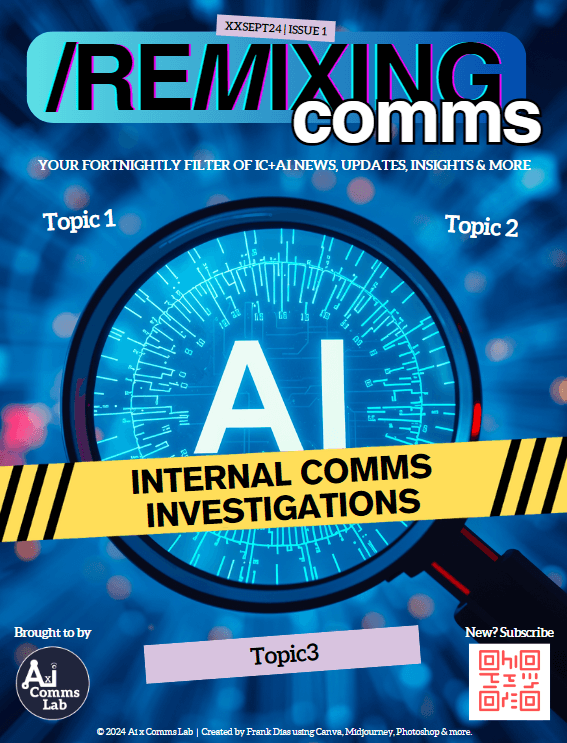
➡️ Subscribe to my newsletter /REMIXING comms
Practical AI news, insights, learning & more curated & filtered for your inbox.
© 2025 Ai x Comms Lab