KEY POINTS: - We solve the AI implementation gap - transforming teams from AI-curious to strategically confident in days, not months - Personal trainer approach for AI adoption - hands-on practice with your real work, not theoretical training - People+AI methodology - amplifying human value rather than replacing teams - Three-tier service model: from single workshops (immediate impact), to workflow and process redesign, to full department transformation (3-15 months) - Proven results with 1,000+ people globally, 10/10 satisfaction scores, working with approved enterprise tools
Talking about the potential of IC➕AI
I was invited to talk about the potential of AI integrated into internal communications and shared my insights with an in-house IC team tasked with an AI research project. Here's a summary of the Q&A.
🤖🤖🤖🤖🤖🤖🤖🤖🤖🤖🤖🤖🤖🤖🤖🤖🤖🤖🤖🤖🤖🤖🤖🤖
Q. What are some use cases for AI/chatbots in the IC space?
There are many use cases. It's really about understanding your workflows and the tasks that form them. Here are just a few key areas where AI can enhance IC processes:
💡 Writing & content creation: AI can assist with various types of writing, including presentations, communications plans, and stories, etc.
💡 Translation: AI tools can be used to translate content, potentially more accurately than some traditional translation software.
💡 Research & data analysis: AI can quickly process large amounts of data, categorise information, and provide insights.
💡 Survey development & analysis: AI can help create survey questions, categorise responses, summarise, and analyse results.
💡 Campaign ideation: AI can generate ideas for communication campaigns and workshop frameworks.
💡 Sentiment analysis: AI can analyse and categorise employee sentiment from public forums, internal forums, Town Hall Q&A, or other sources.
💡 Transcription & summarisation of interviews or meetings: AI can record natural language so you can record the conversation, summarise the discussion points and actions, and allow you to have a further conversation with the data to help you build out further content.
I emphasised that while AI can assist with these tasks, human oversight and expertise are still crucial for ensuring the quality, accuracy, and relevance of the final output.
🤖🤖🤖🤖🤖🤖🤖🤖🤖🤖🤖🤖🤖🤖🤖🤖🤖🤖🤖🤖🤖🤖🤖🤖
Q. What could we use AI tech for that might free IC people up to do the things only people can do?
There are several ways AI can help IC professionals save time and focus on more strategic work. The above use cases highlight some of those areas.
1️⃣ The first action is to create a list of the work your team are regularly involved in.
2️⃣ Next is to write up the workflows and call out the specific tasks step-by-step of what's involved.
3️⃣ Once you've done that, you should look at those tasks to understand what parts are human-owned and what bits could be enhanced by augmenting AI into the task in collaboration with the user.
Understanding the AI tools available to you and their capabilities is really important so you what to choose when delegating and involving the right AI tools for the right jobs. Get an expert in to help fast track your learning about the tools you're considering to use.
Some areas which general genAI tools like ChatGPT, Claude, Gemini, Copilot can help with which will save an IC person time are:
💡 Data analysis: AI can quickly process large amounts of data (un/structured), allowing comms pros to focus on interpreting results and developing strategies.
💡 Research & categorisation: AI can help gather and organise information, saving time on initial research tasks.
💡 Survey development: AI can assist in creating and categorising survey questions, freeing up time for tailoring questions to specific business objectives.
All of the above need human direction. This is where your expertise and experience is vital in terms of the prompting, instructions and conversations you have with the AI tools. Understanding the quality outputs you're after will help you in devising your interaction and engagement with the tools.
What do you do with the gained "free-time"? Spend more time on strategic thinking and adding value to their work particularly the development of high-quality outputs.
The key is to use AI as a tool to handle time-consuming tasks, just like we do with other tech and tools. Using them well will enable you to focus on areas where your expertise, nuanced understanding, and strategic thinking are most valuable.
🤖🤖🤖🤖🤖🤖🤖🤖🤖🤖🤖🤖🤖🤖🤖🤖🤖🤖🤖🤖🤖🤖🤖🤖
Q. What should we consider regarding potential risks in using AI for internal comms?
As with all things in life there are potential risks to consider when using AI for internal communications. This is where having two foundations are vital:
1️⃣ Ethics & values to ground your decision-making: What are your personal values and principles in IC that you've built up? Both the:
...have their own principles. This is an important starting point to look through and align to your own.
2️⃣ Understanding the pros & cons, opportunities & limitations: Here are a few of the main areas to be aware of when using AI:
💡 Data accuracy & verification: AI tools can produce inaccurate results, especially in data analysis. It's crucial to fact-check and verify AI-generated outputs.
💡 Lack of source transparency: Some AI models don't provide sources for their information, making it difficult to verify the accuracy of the output.
💡 Hallucinations: AI can sometimes generate false or made-up information, especially when it doesn't have a clear answer.
💡 Data privacy & security: Be cautious about inputting sensitive or identifiable information into AI platforms, especially public ones.
💡 Trustworthiness of AI tools: Be wary of lesser-known AI platforms, especially those that don't provide clear information about their ownership or contact details.
💡 Biased outputs: AI outputs, depending on their training and guardrails put in place, can generate biased outputs.
I emphasise the importance of human oversight, critical thinking, and the need to apply our professional knowledge, expertise and experience when using AI tools in internal communications.
🤖🤖🤖🤖🤖🤖🤖🤖🤖🤖🤖🤖🤖🤖🤖🤖🤖🤖🤖🤖🤖🤖🤖🤖
Q. What skills might we need as a comms team?
Several skills comms teams might need when working with AI, however, most of you will have these skills already. It's just about supplementing them using the lens of AI:
💡 Change management skills: Treating AI integration as a change and transformation programme. This should be no different for good, effective first principles of dealing with the communication of change.
💡 Curiosity & question-asking skills: Leveraging your existing ability to ask good questions and adapting it to AI platforms. Knowing how to prompt, understanding your workflows and tasks and understanding the questions you'd ask through conversation and dialogue using a step-by-step methodology to help steer the AI tool towards good quality outputs you can shape into final outputs.
💡 AI literacy: Understanding how AI tools work and how to use them effectively.
💡 Ethical awareness: Considering the ethical implications of using AI in communications. As I mention above, honing and understanding your own principles as well as professional memberships' principles are very important to developing your muscle better to be more active and know what you're regularly looking out for.
💡 Strategic thinking: Applying your strategic skills to integrate AI into our workflows and critiquing the outputs and knowing what the final quality output is that you're after.
💡 Process mapping: Documenting your communication processes to identify where AI can be most effectively integrated and having a good step-by-step approach is vital to design good maps.
While many of these skills are extensions of your existing comms competencies, there's a need to adapt and refine them for the AI context.
🤖🤖🤖🤖🤖🤖🤖🤖🤖🤖🤖🤖🤖🤖🤖🤖🤖🤖🤖🤖🤖🤖🤖🤖
Q. What kind of relevant AI tools are out there?
I recommend several AI tools for IC:
💡 ChatGPT-4o: A good sparring partner. A bit formal in places. Great at data analysis and all-round genAI text.
💡 Claude 3.5: My new favourite, providing more human-like and emotional responses. Good at data analysis and all-round genAI text.
💡 Fathom, Otter AI, Limitless, Read AI, Fireflies, and many more: A decent transcription AI tool, with good accent recognition and summary capabilities is important for your AI toolkit.
💡 Perplexity: Great at searching and researching the web, and more importantly, it provides sources for its outputs.
Focus on a few key AI tools that you trust and know rather than trying to use every available AI tool out there. There are just too many shiny objects.
🤖🤖🤖🤖🤖🤖🤖🤖🤖🤖🤖🤖🤖🤖🤖🤖🤖🤖🤖🤖🤖🤖🤖🤖
If any IC people would like to invite me to share my AI and comms experience, wisdom, insight, tips, expertise and guidance with them, please get in touch at frank@aixcommslab.uk or DM me on LinkedIn.

Frank Dias
An employee comms pro with 15+ years of exp across diverse industries.💗s crafting impactful strategies, narratives, & experiences aligned with business priorities. Specialises in🌍IC &engagement, change mgt, & business partnering.
Follow Frank on ➡️LINKEDIN
At Ai x (by) Comms Lab, we help teams practically master strategic AI use for business impact. We teach you how to fish🎣 with AI🤖, so you can fish to bring your strategic use of AI to life with guidance and support on your journey.
Are you ready to transform your team into strategic AI masters? Get in touch ↖️


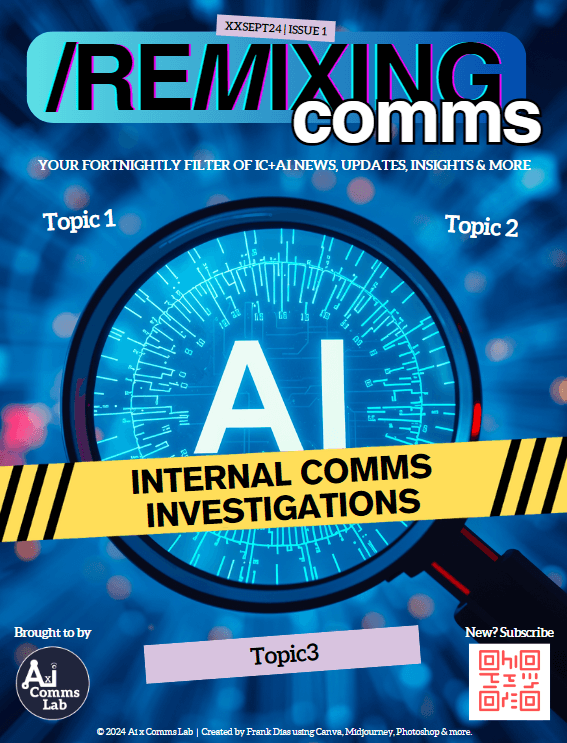
➡️ Subscribe to my newsletter /REMIXING comms
Practical AI news, insights, learning & more curated & filtered for your inbox.
© 2025 Ai x Comms Lab